Just guessing is totally fine – it's only about a first impression.

Bud rot in September.
Where does the infection usually start?

You know the fungus – the calendar is what's new

How Botrytis works is in the pest course: not an attacker but an appointment. It needs moisture that stays long enough, and tissue that obliges.

Outdoors nothing about the biology changes. What changes is the frequency of the appointment.

Indoors the moisture window is an event: one night, one mistake, a few hours. Outdoors in September it is the normal state – longer nights, morning dew, rain in between, cool air that holds less water. And all of it exactly when the flower is ripe and dense.

The fungus isn't different outdoors. The calendar is.

The currency is hours wet

There is no humidity value at which it starts. What counts is temperature times duration.

This is best measured in other crops – strawberry and viticulture have decades of research on it. There the rule is: a flower infection needs at least about four hours of free wetness at 15 to 22 °C. At 20 °C and 24 hours of wetness practically every flower gets infected. And the cooler it is, the longer it has to stay wet – the fungus optimum lies around 18 to 21 °C.

The exact hours apply to strawberries, not cannabis; nobody has measured this for cannabis flowers in the field. But the pattern holds, and it is what you need:

Not "how humid was it", but "how long did it stay wet".

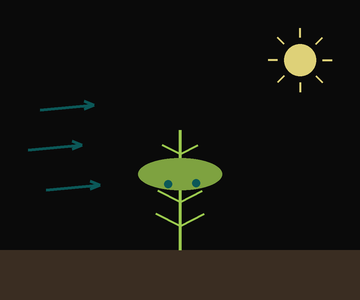
Two leaves on a clear night: under open sky the leaf cools and forms droplets, under cloud it stays dry.

Wet without rain

Here's the part you never learn indoors: it doesn't have to rain for the plant to get wet.

On a clear, still night the leaf radiates heat into the open sky and becomes colder than the air around it. Once it drops below the dew point, water condenses on it. That's why dew formation begins when the weather station reports 91 to 99 per cent humidity – the leaf is simply colder than the thermometer.

Measurement series with wetness sensors in four countries show how much this adds up: in late summer and autumn, leaf wetness duration regularly runs to 10 to 20 hours a day. The literature puts it plainly: dew is often the main contributor to leaf wetness.

Set that against the four hours from before. Autumn delivers the moisture window every single morning – entirely without rain.



Two probes at a bud: the inside values run higher and fluctuate far less over day and night than outside.

The cola makes its own weather

Probes were inserted into inflorescences while ambient air was measured at the same time, four times a day over three weeks.

The result: inside a 49-day-old inflorescence, humidity averaged 15.4 percentage points higher and temperature 2.5 °C higher than in the surroundings. While 34 to 76 per cent was measured outside, inside it was 60 to 87.

But the real finding lies in the fluctuation: the values outside varied significantly more than those in the bud. The cola is not only moister and warmer – it is more sluggish.

And that is exactly what makes it a reliable habitat. Outside the weather jitters and dries off in between. Inside it stays damp. The fungus doesn't need record conditions, it needs consistency – and the plant's own structure supplies it.

A plant with an inflorescence beside a temperature scale: under the sun the bud marker rises far above the leaf marker, after blackout it drops steeply back.

And it stores heat

The same measurements found something else – with a thermal camera. The inflorescences were noticeably warmer than the surrounding foliage, and the hottest spot of a cola reached 41.4 °C on a sunny day.

What happened next is more interesting: after blackout, the temperature inside the inflorescence dropped from about 36 to 24 °C within 30 minutes. It charges slowly and discharges fast.

What that means outdoors is a conclusion, not a measurement – but an obvious one: whatever heats up strongly by day and gives it off quickly at night can, under open sky, also fall below the surrounding air temperature. And dew settles precisely where that happens.

So the cola is not only the moistest part of the plant, it is also the coldest one in the morning.

What you see in September happened in August


Inflorescences were deliberately inoculated with spores at different points of the 49-day flowering period, and then observed for when the infection became visible. The strongest infection came from inoculation on days 14, 21 and 28 – clearly more than on day 7 or 35. And when did it become apparent?

You can't ventilate – but you can let it dry

Indoors you turn up the exhaust. Outdoors you have no switch – but you have the site, and the site is your ventilation.

That this works has been measured. In the greenhouse, fans above the plants reduced humidity inside the inflorescence by 11.6 percentage points – and bud rot incidence by an average of 81 per cent. Outdoors you have no fans, but viticulture has done the field trial: removing leaves around the grape zone measurably changes the microclimate and clearly reduces Botrytis.

For the site that means:

Morning sun shortens the dew wetness where it lingers longest.
Wind replaces the exhaust you don't have.
Spacing lets air between the plants.

There is no cannabis field trial pitting morning sun against a shaded spot – this is a conclusion from two measurements, not a measured value. But the chain is documented at both ends.


Two sites, the same overnight rain, the same variety. The difference is not how wet they got – but how long they stayed that way.

Open with morning sun
Still and shaded
Still and shaded Open with morning sun

Mid-September, a week of steady rain is forecast.
Your buds are nearly but not fully ripe. What do you do first?

"Feed lean against mould"

A stubborn piece of advice for late flower: feed less, then the cells won't be so watery and the fungus will have a harder time. Sounds logical. Is it?

The last adjustment is the calendar

At some point everything is decided. The variety is set, the site is set, the buds are dense, and the forecast says rain. Then you have exactly one decision left: when to harvest.

That's not an emergency exit but a genuine trade-off. A few days earlier costs you some ripeness. A few days later can cost you part of the harvest – and bud rot doesn't stand still, it spreads through the stand.

There is no formula. There is only the question: which is more likely – that the coming days bring ripeness, or that they bring the fungus?

And that closes the arc back to the second lesson. An early-flowering variety solves this exact problem one level earlier: it never poses the question, because it's finished in September. What you decide in autumn with the harvest knife, you could have decided in spring with the choice of variety.

The key takeaways

  • It's not the humidity threshold that counts but temperature times hours wet – from about four hours it gets critical
  • Dew forms without rain through radiative cooling; in autumn the leaf is often wet 10 to 20 hours a day
  • The inflorescence is 15.4 percentage points moister, 2.5 °C warmer and fluctuates less than the surroundings
  • Visible infection appears only on days 33 to 41 – regardless of when infection occurred
  • The site is your ventilation: morning sun, wind and spacing shorten wetness duration
  • The last adjustment is the harvest date – the one before it was the choice of variety in spring

🎯 Hands-on mission

In September, open the densest inflorescences once a week and look inside – not at them. If you're unsure about a coating or discolouration, submit a photo to the consultation. With bud rot every day you know earlier counts.

Submit a photo →

Lesson complete!

One control has stayed with you, and now it matters: the watering can. Outdoors it works against weather you cannot set.

  • I know it isn't a humidity threshold that counts but temperature times hours wet
  • I know dew forms without rain and extends the wetness every morning
  • I understand why the inflorescence creates its own microclimate
  • I know visible infection appears weeks after infection happened
  • I know my last adjustment: the harvest date
To the photo consultation → Continue to the next lesson →

Something still unclear?